Tuesday, November 14, 2017

Yoga Poses to Ease Post-Workout Muscle Soreness.


importance_flexibility_mobility_fitness
So you killed leg day, but now you can’t even walk to the bathroom without being in pain. Post-workout muscle soreness is both a good thing and a bad thing. It’s a good thing because that indicates that you had a successful, muscle-building workout. Soreness is caused by the micro-tears in the muscles from working really hard. If you are sore, good job! You are building muscle.
Unfortunately, muscle soreness is can also be pretty uncomfortable- even painful- and also quite inconvenient in a lot of situations. If you work out a lot, you are going to be sore all the time, and that’s just no fun. 
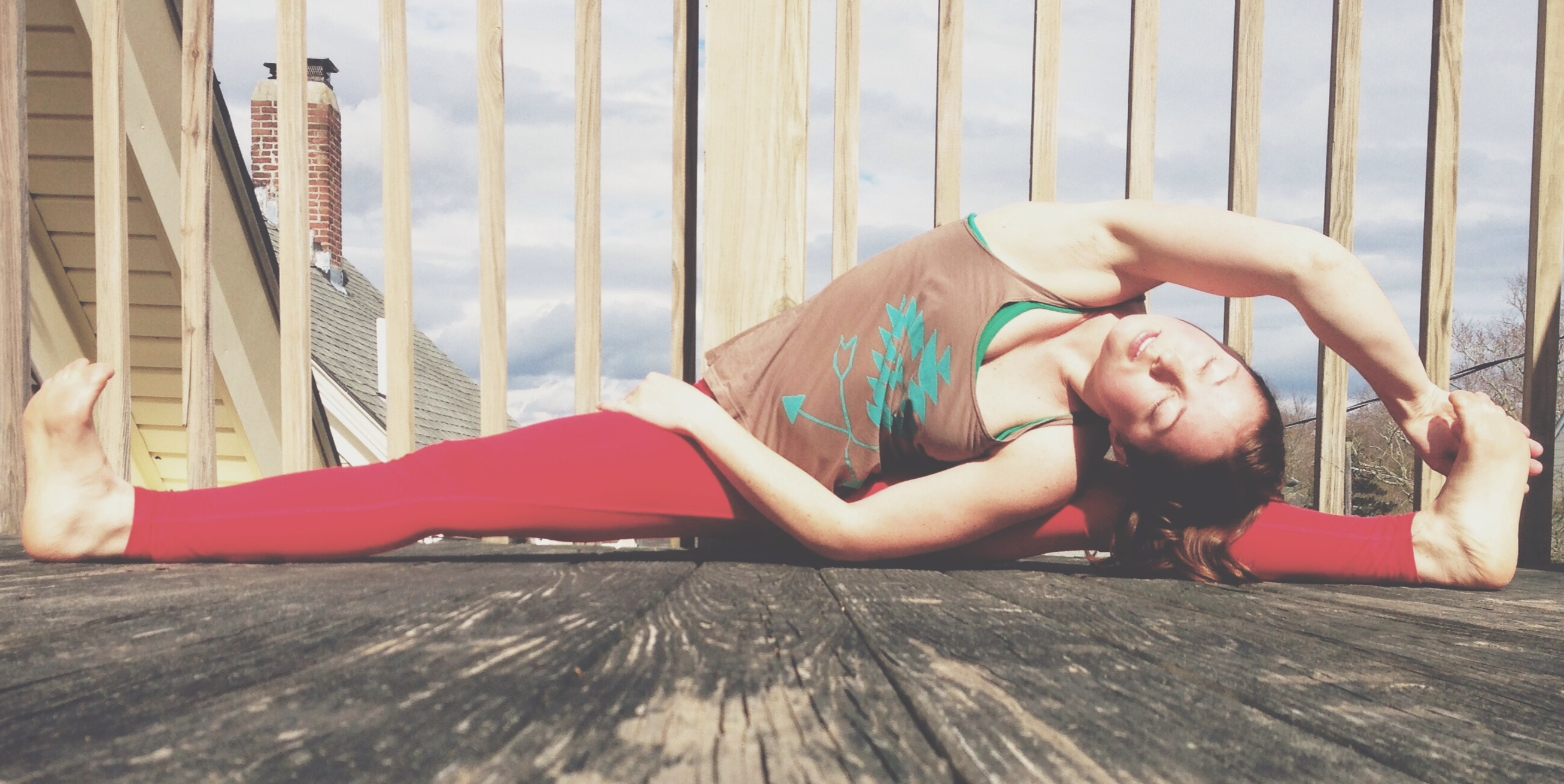
Here are yoga poses for post-workout muscle soreness. These poses will help ease muscle soreness, as well as increase your mobility & flexibility for your future workouts.

Yoga Poses for Post-Workout Muscle Soreness:


Arms:

yoga poses sore muscles post workout
Standing Forward Bend
Clasp your hands together behind your back, hinge forward at the hips, let your head hang, and bring your arms overhead. Sway slowly from side to side, letting the weight of your arms stretch your shoulders at different angles.
yoga poses sore muscles post workout
Standing Side Bend
Stand with your feet together and your arms overhead with your palms together. Keeping your arms straight- or close to straight- lean to the left and right, taking the time to feel your sides open.
yoga poses sore muscles post workout
Wide Legged Forward Bend Twist
Stand with your feet placed 3-4 feet apart, and hinge your torso forward at the hips. “Roll” your spine down and rest your hands on the floor, letting your neck & head relax. Bring one arm upwards and look up at it, feeling your spine twist and open. Switch arms and repeat.

Legs:

yoga poses sore muscles post workout
Standing Forward BendStand with your feet together, and bend over, “rolling” your spine down as you reach towards the floor. Let your neck relax and your head hang.

yoga poses sore muscles post workoutReclining Bound Angle Pose
Start in an upright (sitting) Bound Angle Pose (the “butterfly” stretch), then roll your spine back until your are laying down. This will stretch your hip flexors (and ladies take note, this pose is also great for relieving menstrual cramps).
yoga poses sore muscles post workout
Camel Pose (Ustrasana)
Begin on your knees, with your arms at your side, looking straight forward. Slowly draw your arms up over your head, then using one arm at a time, reach your hands behind you to grasp your heels. Make sure your hips are positioned over your knees, then relax your neck and shoulders so your head hangs back and your throat feels “open”.
yoga poses sore muscles post workout
Crescent Lunge
Start in a high lunge, then slowly lower the back knee down to the floor. Keep your torso to an upright position, and make sure your front knee does not extend forward over your toes.

Back:

yoga poses sore muscles post workout
Wind-Relieving Pose
Lay with your back flat on the ground and legs fully extended. Bring both knees in towards your chest, clasp your hands around your legs, and round your back so your buttocks come slightly off the floor. Attempt to bring your forehead to your knees, then rock slowly from side to side to gently massage your spine.
yoga poses sore muscles post workout
Two Knee Spinal Twist
Lay with your back on the ground, and your knees bent. Let your knees fall to one side, and look in the opposite direction, with your arms extended to both sides.

yoga poses sore muscles post workoutChilds Pose
Sit with your knees slightly apart and folded underneath your body, then lean forward to rest your forehead on the ground. Rest with your arms by your sides, or increase the stretch by reaching your arms forward.
yoga poses sore muscles post workoutPlow Pose
From a sitting position, roll your spine backwards and down to the floor, and bring your knees into your chest. Place your hands on your lower back for support as you extend your legs upward towards the ceiling. Finally, lay your arms on the floor when you are stable, lower your legs down towards your face, and aim to touch your toes to the floor above your head.
yoga poses sore muscles post workoutDownward Dog
Stand with your feet together, hinge forward at the hips, and bend your knees so that your palms are flat on the floor (if they aren’t already). Shift your weight so that your arms are supporting you as you hop or walk your legs back. Use your hands to push your body back towards your heels until you feel a stretch throughout your back and legs

Abdomen:

yoga poses sore muscles post workoutSide Plank Pose
Starting from either Plank Pose or Downward Dog (whatever you are more comfortable with) shift your weight to one arm, and rotate your body to the side. Engage your core and lift your hips upwards, and extend your free arm overhead.
yoga poses sore muscles post workout
Sphinx Pose
Lay on your stomach and place your elbows below your shoulders. Prop yourself up on your forearms, taking care to keep your shoulders down and away from your ears.
yoga poses sore muscles post workoutCobra Pose
Lay on your stomach and place your hands flat on the floor beneath your shoulders. Slowly press up with your arms, straightening them only to the a point that is still comfortable for your back. Take care to keep your hips on the ground, and your shoulders away from your ears.

YOGA POSES - BEGINNERS

YOGA BASIC MOVEMENTS

These movements are very useful to beginners, who want to start doing yoga but don't have any experience of yoga or any other exercise.
There are several joints in our body, which needs lubrication and movements. The food we consume supplies the lubrication and Yoga and other activities provide the movements. In our regular life some of these joints are overused and some are rarely used which may create problems at later stage in your life. To help these joints maintain their healthy condition Basic Movements are necessary also they are useful to prepare your body to take up Yoga.

PREREQUISITES FOR YOGA

Below 12 years of age Yoga postures should not be practiced for long duration and asanas are to be maintained for very short duration.
Every day you should practice Yoga for at least 30 to 45 minutes to get maximum results.
The best suited time to practice is early morning hours, but it can be practiced in the afternoon after following food restrictions.
Food restrictions - stomach should be empty while practicing, that is you should consume solid food 3.5 hours before practicing and liquid 1 hour before.
Place should be spacious, clean, airy, bright and away from disturbances.
Yoga should not be practiced on bare floor but keep mat or carpet below.
Clothes should be comfortable, loose, clean. Undergarments are necessary.
Yoga prefers vegetarian diet. But avoid spicy and hot diet as much as possible.
Women should not practice Yoga during Pregnancy and menstruation.
One should have faith in Yoga and what he is doing.

BENIFITS

  1. As your body relaxes all your muscles also relax except those muscles, which are used in the movements, so one can easily concentrate on the movement / particular muscle (effort).
  2. Aged and persons having diseases also can do these movements without much strain.

YOGA POSITIONS OR ASANAS

Asana system is the 3rd in Ashtanga yoga, yogasana help achieve physical health, control over mind and power of concentration.
Patanjali has described Yogasana as "Sthir Sukham Asanam", which means a posture that is stable and pleasant. A more broad definition of Yogasana according to Patanjali is "Tatodwanabhighatah" which means practice of Yogasana leads to disappearance of duality of cold-hot, sadness-joy, happiness-sorrow and so on.
Yoga is different from exercise as it doesn't involve speedy movements, but instead very slow and steady movements.
Yoga helps achieve relaxation which reduces stress & strain.
Very few calories are consumed during Yogasana practice and metabolism rate of the body also drops which means reduced Aging Process.
Less food is required as digestive power is increased.

PRE POSITION

Standing Position
Sitting Position
Supine Position
Prone Position

Standing
Sitting
supine
prone

NECK MOVEMENT

NECK MOVEMENT

NECK MOVEMENT - 1

Aim - To increase the flexibility and stamina of neck muscles.
Precaution - People with neck problems like spondilytis should avoid forward bending.
Procedure - Sit in the Vajrasana Position, keep your neck straight, then slowly but without jerk start rotating neck clockwise from left shoulder to backwards then to the right shoulder and to front. Repeat this in anticlockwise direction starting from right shoulder.
NECK MOVEMENT

NECK MOVEMENT - 2

Aim - To increase the flexibility and stamina of neck muscles.
Precaution - People with neck problems like spondilytis should avoid forward bending.
Procedure - Sit in the Vajrasana Position, keep your neck straight, then slowly but without jerk start rotating neck clockwise from left shoulder to backwards then to the right shoulder and to front. Repeat this in anticlockwise direction starting from right shoulder.

SHOULDER MOVEMENT

SHOULDER MOVEMENT

SHOULDER MOVEMENT - 1

Aim - To increase the flexibility and stamina of neck muscles.
Precaution - No specific precautions.
Procedure - Sit in the Vajrasana Position, keep your body straight, with arms by side. Then slowly but without jerk lift your both shoulders upwards as much as possible near to ears, back to normal position.
SHOULDER MOVEMENT

SHOULDER MOVEMENT - 2

Aim - To increase the flexibility and stamina of shoulder and back muscles.
Procedure - Sit in the Vajrasana position, keep your body straight, fold you hands and place left fist on left shoulder and right fist on right shoulder, bring both your elbows together near chest, then slowly but without jerk rotate both these arms in opposite direction, (left arm anticlockwise and right arm clockwise) Repeat this in opposite direction (right arm anticlockwise and left arm clockwise).
Benefits - This posture is useful for people with back problems.

HAND MOVEMENT

HAND MOVEMENT

HAND MOVEMENT - 1

Aim - To increase the flexibility and stamina of hand & shoulder muscles.
Precaution - If you feel strain while lifting your hands above ground then do this with your hands resting on ground.
Procedure - Relax in Shavasana position, keep your hands 6 inches away from your body, legs separated with 12 inch distance between them, lift your hands 1 to 1.5 inch above ground and slowly rotate them towards head without bending elbows, keep the hands parallel to the ground till both the palms meet, place left palm on right palm and stretch hands upwards and legs downwards for 5 to 10 seconds, then slowly but without jerk rotate both the hands back to the normal position via the same path.
Benefits - This posture is useful in increasing the strength of neck, shoulders and the stretching helps retain normal posture.
HAND MOVEMENT

HAND MOVEMENT - 2

Aim - To increase the flexibility and stamina of hand & shoulder muscles.
Precaution - do not bend elbows while doing this.
Procedure - Relax in Shavasana position, keep your hands 6 inches away from your body, legs separated with 12 inch distance between them, raise your hands above ground and slowly take them towards head without bending elbows, place both hands on the ground, stretch hands upwards and legs downwards for 5 to 10 seconds. Then slowly but without jerk bring both the hands back to the normal position via the same path.
Benefits - This posture is useful in increasing the strength of neck, shoulders and hands, the stretching helps retain normal posture.
HAND MOVEMENT

HAND MOVEMENT - 3

Aim - To increase the flexibility and stamina of hand & shoulder muscles.
Precaution - do not bend elbows while doing this.
Procedure - Relax in Shavasana position, keep your hands 6 inches away from your body, legs separated with 12 inch distance between them, raise your hands above ground and slowly take them towards head without bending elbows, place both hands on the ground, stretch hands upwards and legs downwards for 5 to 10 seconds. Then slowly but without jerk bring both the hands back to the normal position via the same path.
Benefits - This posture is useful in increasing the strength of neck, shoulders and hands, the stretching helps retain normal posture.

HAND MOVEMENT - 4

Aim - To increase the flexibility and stamina of hand & shoulder muscles.
Precaution - If you feel strain while lifting your hands above ground then do this with your hands resting on ground. The movements should be slow and continuous.
Procedure - Relax in Shavasana position, keep your hands 6 inches away from your body, legs separated with 12 inch distance between them, lift your hands 1 to 1.5 inch above ground and slowly rotate them towards head without bending elbows, keep the hands parallel to the ground till both forearms cross, in this same cross position raise the arms above and on to the stomach, then slowly bring both the hands back to the normal position.
Benefits - This posture is useful in increasing the strength of neck, shoulders and the stretching helps retain normal posture.

LEG MOVEMENT

LEG MOVEMENT

LEG MOVEMENT - 1

Aim - To increase the flexibility and stamina of legs & hip muscles.
Precaution - The movements should be slow & continuous.
Procedure - Relax in Supine position, keep your hands around head rotating them side ways, then lift your left leg and bring it near to the hip, repeat this procedure for the right leg. Then slowly bring both the hands back to the normal position
Benefits - This helps development of the leg muscles and hip joints.
LEG MOVEMENT

LEG MOVEMENT - 2

Aim - To increase the flexibility and strength of legs & hip muscles.
Precaution - The movements should be slow & continuous. Do not bend the knees.
Procedure - Relax in Supine position, keep your hands close to your body, then lift your left leg 30 to 40 degrees above ground level and rotate it in the clockwise direction without bending knees, repeat this procedure for the right leg.
Benefits - This helps leg muscles and hip joints.
LEG MOVEMENT

LEG MOVEMENT - 3

Aim - To increase the flexibility and stamina of legs & hip muscles
Precaution - The movements should be slow & continuous. Do not bend the knees.
Procedure - Relax in Supine position, Move your hands around and place them at shoulder height, parallel to the ground, then lift your left leg and turn it to the right side as far as possible touching the ground. Repeat this procedure for the right leg. Then slowly bring both the hands back to the normal position.
Benefits - This helps leg muscles and hip joints.

KNEE MOVEMENT

Aim - To increase the flexibility and stamina of neck muscles.
Precaution - People with neck problems like spondilytis should avoid forward bending.
Procedure - Sit in the Vajrasana Position, keep your neck straight, then slowly but without jerk start rotating neck clockwise from left shoulder to backwards then to the right shoulder and to front. Repeat this in anticlockwise direction starting from right shoulder.
Benefits - This helps knee joints and hip joints.

Monday, November 13, 2017

7 Easy Steps to Starting Your Home Yoga Practice Today.

Starting your own home practice can seem daunting, confusing and awkward. But instead of using that as an excuse, let’s embrace it.
Here are seven steps that will make starting your own yoga practice today far easier than you thought:
1. Just start.
A home yoga practice isn’t just for those who are teachers or those who have “been doing yoga forever.”
There’s no specific time when you are ready to start your own home practice, but if you’ve thought about it, I’d say the time is now. Getting lead by a teacher in a class is awesome, but there comes a time, when to dig even deeper, you have to cultivate your own practice.
Practicing your own yoga sequence tailored to how your body feels, the mood you’re in and what’s going on in your life is something magical that only you can create.
2. Keep it short.
The goal of a home practice is not to reach 60 or 90 minutes of graceful, perfect flow. The goal is to move, feel good, and de-stress. Start with even just a couple minutes and see where it takes you.
3. Be okay with it feeling awkward.
Even if you have been taking group classes for years it will feel strange not being led by someone. Embrace the awkward and drop the judgments. Give yourself time to get used to it. you will eventually. It doesn’t need to look pretty.
4. Your mind will wander, your roommate will interrupt, your dog will lick your face.And that’s fine. If you have a space where you can be uninterrupted that’s a plus, but most of us don’t. Eventually you will learn to not feel so weird in front of whoever might be getting ready for work around you. Heck, maybe they’ll join you.
Slowly but surely, the space in which you roll out your mat, wherever that may be, will feel like your yoga space regardless of what is happening around you or what the space looks like.
5. Put your phone and computer out of sight and earshot.
This is an obvious one. Unplug and make these distractions a no-brainer by keeping them away. They will be there when you’re done.
6. Pick poses (or even just one) that feel good.
See what comes natural to you. Is there a pose in a yoga class that you just love when it comes up because it feels so awesome? Try that one. Are you feeling achy in certain places from exercising the day before? Anything in life that’s keeping you hung up? Hone in on that.
Yoga is linking breath with movement. It’s that simple. So if all you’re in the mood for are some simple relaxing stretches, that’s yoga.
7. Stick with it (and have fun!)
Just like anything else, a routine takes repetition. Give yourself time to get into a rhythm without judgment or striving for perfection. Go on and get silly when you want to, move in easy ways that feel good, and most importantly: do what will put a smile on your face.

HOW TO LIVE THE YOGA LIFESTYLE:


LIVING THE YOGA LIFESTYLE: THE LIMBS OF YOGA.


DESPITE MOST PEOPLE COMING TO YOGA FOR THE POSTURES YOGA IS ACTUALLY A LIFESTYLE AND OUR YOGA PRACTICE BECOMES MOST BEAUTIFUL WHEN WE LIVE OUR YOGA EVERYDAY. THE YAMAS AND NIYAMAS IN YOGA PHILOSOPHY TEACH US ABOUT OUR ATTITUDE TO OTHERS AND THE WORLD AROUND US (YAMAS) AND HOW WE TREAT OURSELVES AND OUR ATTITUDE TO OURSELVES (NIYAMAS) BASED ON THIS ANCIENT WISDOM HERE ARE 5 WAYS THAT YOU CAN LIVE YOUR YOGA EVERYDAY.

1) SATYA – HONESTY (YAMAS)

Satya is about living our lives as honestly as possible, being honest with others and ourselves. Before you speak try to notice the intention behind what you are planning to say. Is it to demonstrate your knowledge, manipulate, show kindness or support? If in doubt an old Sufi tradition advises us to speak only after our words have managed to pass through four gates. At the first gate, we ask ourselves, “Are these words true?” If so, we let them pass on; if not, back they go. At the second gate we ask “Are they necessary?” At the third gate we ask “Are they beneficial?” and at the fourth gate, we ask, “Are they kind?” If the answer to any of these is no, then what you are about to say should be left unsaid.

2) APARIGRAHA – NON POSSESSIVENESS (YAMAS)

Aparigraha is about letting go of attachment to material things and understanding that change is the only constant. Generosity is a powerful way to develop aparigraha – letting go and trusting it will always come back. Buy a gift or meal for a friend or give anonymous donations to someone in need or charity.

3) SAUCHA – CLEANLINESS (NIYAMAS)

Cleansing not only your physical environment and appearance and also what we take into our bodies, hearts and minds. Watch your diet. Can you eat more foods that cleanse and nourish your body? What is your motivation behind comfort foods?

4) TAPAS – DISCIPLINE (NIYAMAS)

Photos courtesy of MeditationMusic.net


Tapas means to be disciplined in every area of your life from dedication to your practice, to sitting in meditation every day. Schedule a time every day for asana and meditation and commit to doing it every day. If needs be get up 5 minutes early – what will change your life more, 5 minutes extra sleep or 5 minutes of meditation?

5) SVADHYAYA – SELF STUDY (NIYAMAS)

This is study of the self and also the wisdom of those who have come before us, so studying texts and books. Take time as often as possible to study yourself and your actions, words. Meditate on anything causing you problems and let your own inner wisdom talk to you.

What is Yoga? Practical Philosophy and Science of Self-Realization.


Yoga Philosophy and Science

What is Yoga? Although yoga is still considered by many as merely a popular physical practice that has some mental benefits it is actually the science of Self-realization. Yoga offers a practical philosophy of life which includes scientific techniques developed by the ancient yogis to help us discover our true nature.

What is yoga?


The Sanskrit word yoga means "to join" or "to unite". The yogis explain that yoga is the union of the self with the higher Self, union of the individual soul with the Supreme Soul, union of Atman with Brahman. In other words yoga is the realization that we are not mere human beings but actually one with the Supreme Consciousness or Soul. This is called Self-realization or samadhi.

The sage Patanjali defines yoga in his Yoga Sutras as "Yoga Chitta Vritti Nirodah (Y.S. I.2.)" which can be translated as "Yoga is the cessation of the modifications of the mind".

In the eastern traditions the mind is usually compared to a lake. Only when the waves of the lake have become still we are able to see the bottom of the lake. Similarly when the waves (vrittis) or modifications of the mind (chitta) becomes still we are able to see the true Self. In that state the yogi realizes that there is no difference between the individual soul and the Supreme Soul, he has attained the state of samadhi. He is then able to remain perfectly balanced or any circumstances unaffected by the pair of opposites like pleasure and pain, gain and loss and success and failure.


Yoga: Practical Philosophy of Life and Science of Self-realization


The yogis' gift to humanity was to develop or to discover a practical philosophy of life and the techniques to accomplish that stillness of the oscillations or modifications of the mind so we could clearly see our true nature and attain that state of unity.

The four main paths of yoga (Jnana Yoga, Karma Yoga, Bhakti Yoga and Raja Yoga) give us the wisdom and a practical philosophy that we can apply in our daily lives to help us overcome any distress or painful situation reducing in this way the vrittis or modifications that obscures our true nature.

The Raya Yoga path also offers scientific techniques of meditation and techniques to purify the body and mind as an aid for the meditation practice which ultimately brings that same stillness of the modifications of the mind.

There is no place for superstition or blind faith in yoga. The yogis gave us the techniques and asked us to practice and test them by ourselves like scientists, using our own mind and bodies as our laboratories, so we could become our own therapists.

"The whole technique of yoga, its practice and restraint, is aimed at disassociating consciousness from its identification with the phenomenal world, at restraining the senses by which it is ensnared, and at cleansing and purifying the lens of citta, until it transmits wholly and only the light of the soul" B.K.S. Iyengar - Light on the Yoga Sutras of Patanjali


The four main paths of yoga


The yogis understood that each one of us has a different temperament, different character and tendencies due to our past impressions or samskarasso they gave us four main paths to choose according to our own capacity and temperament. These four paths are described in the ancient and sacred Indian text, The Bhagavad Gita. Although apparently very different each of these paths lead to the same goal: Self-realization.


Jnana Yoga, the path of wisdom

For the philosophers, who naturally feel inclined to reflect on who the "I" is, where do we come from, where are we going to, the real nature of reality and so on, the path of wisdom or Jnana Yoga is the most suitable.

By using the intellect to contemplate on the nature of the Self the jnana yogi ultimately transcends the intellect developing the jnanaor wisdom through intuition which destroys the veils of ignorance or avidya. The illusion of duality or the existence of subject and object disappears and the yogi become fully aware of the ultimate reality.

Karma Yoga, the path of action

For those who are fully active in the world, involved in different kinds of works the path of action or Karma Yoga is the best. Karma yoga is a practical philosophy that we can all apply in our daily lives since we all have to inevitable perform actions or do some kind of work in this material world.

By working selflessly, with a sense of duty and without attachment to the fruits of work, constantly remembering that he is not the doer the karma yogi purifies his mind and becomes free from all bondage created by his actions until he attains the ultimate freedom of samadhi or Self-Realization.


Bhakti Yoga, the path of devotion and control of emotions

For those who are of emotional and devotional temperament, who prefer to see the Divinity outside of themselves to be able to adore and prostrate at Her/His feet the path of devotion or Bhakti Yoga is recommended.

By using the power of emotions and directing them towards the Lord the yogi purifies his mind and develops concentration. That concentration on the form of his Lord (or on the devotional feeling towards the Lord) leads to a state of meditation until ultimately the devotee fully identifies with his Lord. Then there is no difference anymore between the devotee, the act of devotion and the Lord, they become One.

Raja Yoga, the Royal Path

And for those who are mystics, inclined to discover the potential of the mind and will power by practicing the scientific techniques of concentration and breath control the Royal Path or Raja Yoga is their preference.

The essence of the Raja Yoga psychology and its techniques are described in Patanjali's Yoga Sutras and its core teaching is summarized in the Eight Limbs of Ashtanga Yoga. The Eight Limbs describe the preliminary practices for mental and emotional purification and the step by step process of meditation that leads to samadhi or Self-realization.

The raja yogi sits still in a stable and comfortable posture (asana) and by regulating his breath (pranayama), disconecting the mind from the senses (pratyahara) and focusing the mind on an object of concentration (dharana) enters into a state of meditation (dhyana) until ulimately he reaches the state where there is no more duality but only unity (samadhi). The meditator, the act of meditation and the object of meditation become One.

The Raja Yoga path is called the Royal Path because it includes all the other paths:

The raja yogi prays to The Lord of life (Bhakti Yoga) that resides within himself (Jnana Yoga) before his meditation practice (Raja Yoga) and without attachment offers the results of his mediation practice for the benefit of all beings (Karma Yoga).

Raja Yoga: The Royal Path


The four main paths complement each other


These four paths are not mutually exclusive, they actually complement each other. Without dharana or concentration the jnana yogi wouldn't be able to focus the mind on one subject to contemplate upon. Without jnana or wisdom the bhakta would become a fanatic. Without bhakti or devotion the meditations of the raja yogi would become dry and would strengthen the ego-consciousness.

One my choose to focus primarily in one of these four paths but ultimately all of them are applied in the path towards Self-realization.


Hatha Yoga: the physical yoga


And now we finally come to Hatha Yoga, the physical yoga practice best known by its asanas or yoga postures which are so popular nowadays in the western world and which most people know as yoga.

All forms or methods of physical yoga like Ashtanga yoga, Iyengar Yoga, and those forms developed in the west like Power Yoga, Vinyasa and so on are just different forms of Hatha Yoga.

The raja yogi realized that a sick, weak and impure body was an obstacle to any endeavor to sit still, become silent and focus the mind on one point for the practice of meditation. So in order to advance in the path of Raja Yoga, to prepare the body and mind for the practice of meditation the yogis developed a preparatory practice, a system which they called hatha yoga to help the sadhakas or spiritual aspirants achieve that stillness of the body and mind.

"Salutation to Adinatha (Siva) who expounded the knowledge of Hatha Yoga, which like a staircase leads the aspirant to the high pinnacled Raja Yoga." ( Hatha Yoga Pradipika I.1)

"Yogin Swatmarama, after saluting his Guru Srinatha explains Hatha Yoga for the attainment of Raja Yoga." (Hatha Yoga Pradipika I.2)


Ha-tha and the Yin-Yang


Ha-tha, similarly to the Yin-Yang from the Chinese tradition, represents the opposite but complementary forces present everywhere in nature.

"Ha" represents the yang, sun, male, extroverted, positive energies, pingala or right nostril breath flow and left brain hemisphere, and "tha" represents the yin, lunar, female, introverted, mental, negative, ida or left nostril breath flow and right brain hemisphere. The aim of Hatha Yoga is the balancing of these two seemingly opposing forces. When these two forces are balanced an awakening starts to take place.


What are the benefits of the asanas or physical yoga postures?


The asanas, or physical yoga postures which are the main characteristic of hatha yoga, work at different levels:

  • At the physical body level they work by developing flexibility of the spine and the different muscles in the body. They tonify the internal organs by the gentle massage given by the postures which increases the blood flood to stimulate healing and recovery, and they also help to strengthen the muscles and develop stamina.
  • At the energetic level they help to remove blockages in the flow of prana or vital energy which are stored in the different joints of the body.
  • At the mental level they help to develop concentration, awareness and mental stillness.

The asanas are not the only component in hatha yoga. Pranayama (breath regulation exercises), shatkriyas (cleansing practices), mudras (energy seals) and bandhas (energy locks) are also important components of Hatha Yoga. All of these scientific techniques are used by the hatha yogi to help purify his body and mind to make them fit for the practice of meditation.


Anybody can practice yoga


But these four paths of yoga (including the wisdom, the philosophy and the physical practice) are not only for the Indian yogis or Hindus. Since yoga offers only scientific techniques and a practical philosophy of life which has been tested by the sages and which requires no blind faith but only a constant and regular practice it can be used by all regardless of their beliefs, cultural background or religions.

As a matter of fact these four paths are just labels that describe a specific way of living, a philosophy that one might be already applying in his/her life consciously or unconsciously, so even those who say that don't believe in yoga and don't want to have anything to do with it might actually be already practicing it without knowing it.

For instance, the Christian sings and dances with full devotion to glorify God the all mighty (Bhakti Yoga), studies and contemplate on God's words recorded in the Holy Bible (Jnana Yoga), sits in silence and prays to God until silence itself becomes the prayer (Raja Yoga) and serves the community by volunteering in his temple and by praying for others (Karma Yoga).


This is just a small introduction to yoga (although quite a long post) as a practical philosophy of life and science of Self-realization. There is so much to tell about the philosophy of yoga and it's scientific techniques and I'm very excited to continue learning and sharing more in the future, so excited that it is creating a vritti in my chitta. Lol. I guess I need to relax more, apply the Karma Yoga philosophy and take it one step at a time, or rather one post at a time.

10 Ways In Which Yoga Can Change Your Life.

There is no better investment.


If there is one thing that you could do just for yourself—purely and selfishly for yourself—consider yoga.
As the joke goes, "Money can't buy happiness, but it can buy a yoga class, and it's basically the same thing!"
Seriously, though, it will be the most profound investment you will make.
BKS Iyengar was right when he said, "Yoga is like music: the rhythm of the body, the melody of the mind, and the harmony of the soul create the symphony of life."
Why? Here are 10 reasons why you should explore yoga:

1. Not to lose weight, but to get to your optimum weight

When you start a yoga practice you will see your weight fall, gradually, to what is right for your body. And then it will stay there, even if you increase your yoga time. Because yoga works with your body to find what's right for you.
Weight loss is a consequence.

2. To start listening to your body, its needs, its pace and its importance

Once you become aware of the most incredible machine that is your body, you will find yourself stretching on your own, in a weird way, in the middle of an asana, just because it felt right. Later, if you look up, what you did instinctively, it will probably be an asana. You see, your body guides you to what it needs.
Self-healing becomes a consequence.

3. To accept yourself as you are

Yoga makes you aware of the uniqueness that is only you in the whole universe. You slowly rise from the rat race and create your own goals. After that, you are not bothered by others' judgements, opinions and rules. You create your own life.
Accepting others is a consequence.

4. To be patient

Each asana takes effort and time to master, just like everything else in life. You will gradually see the rewards as you become more flexible, breathe deeper, have more rested heartbeats, less white hair/wrinkles and a looser waistband. You will drive slower and enjoy the music more.
Accepting life is a consequence.

5. To learn self-control

You inculcate discipline/ habit/exercise in your daily life. You learn the union of mind and body. They say, the mind is the lord of the body. Guess what, the breath is the master of the mind!
Good health becomes a consequence.

6. To just BE

Try sitting still for one minute without your email, Facebook, WhatsApp or Candy Crush (or whatever is the rage these days). Are you able to? Did you fidget? Are you ok with just the sound of your breathing? If you can, then please discard this article right away. If not, start practicing now.
Mindfulness is a consequence.

7. To be still—physically, emotionally and consciously

When you do that, your creativity and productivity will bloom. You will develop ideas you didn't know you were capable of. You will find new capabilities and dimensions in your personality.
Success becomes a consequence.

8. To heal

Your body and mind have taken wear and tear to a degree that you are unaware of. Yoga fast-tracks healing by increasing blood and oxygen supply to vital organs.
A longer life is a consequence.

9. To be happy

Yoga stimulates the production of hormones that give you a sense of happiness and well-being. When this becomes are baseline, you are bound to stay away from bad habits and influences.
A good life is a consequence.

10. To be a better person

With patience and a sense of inner well-being, you become a better spouse, parent, sibling, worker, manager and friend. You drop judgements and inhibitions when you drop onto the yoga mat. With deeper breaths, you form deeper perspective on relationships, priorities and the world in general. You become humble and grateful, giving and receiving freely.
A wholesome life is a consequence.
***
That yoga has umpteen benefits for physical and mental health is now mainstream knowledge. The asanas are meant to exercise your whole body, right from your head to your small toe. What's more, anyone—whether they are five or ninety-five—can do some form of yoga, since it is usually a gentle process. You will never hear a yoga teacher say, "Get down and give me 10 more pronto." You'll probably hear soft music and smell incense in your class, all combining to create a rejuvenating experience.

The Red Tea Detox - Weight Loss System - WATCH NOW

The Red Tea Detox by Liz Swan Miller is a new rapid weight loss system that can help you lose 14 pounds of pure body fat in jus...